
“He who has a why to live can bear any how.” Friedrich Nietzsche
VANTAGE POINT Conversations, 7 April 2026
Meaning, Purpose, and What Makes Us Human in the Age of AI
There is a question underneath all the noise about AI.
Not how we keep up.
Not how we stay relevant.
Something quieter than that.
Why does any of it matter?
It’s easy to set that question aside. To treat it as philosophical. As something to come back to when things settle down.
But are things settling down?
Here is what I’ve noticed: the people who are navigating this moment with the most clarity aren’t the ones with the best strategy. They’re the ones who still know why they’re here.
That, I think, is worth pausing with.
When the why goes missing
Nietzsche understood something I keep coming back to.
A person can handle almost anything: uncertainty, disruption, loss, change, if they’re anchored to a reason for it. Purpose isn’t just motivational. It holds a person together when the world around them becomes unrecognisable.
When that anchor loosens, something shifts.
People don’t just feel uninspired. They drift. They disconnect. They fill the quiet with noise, scrolling, outrage, endless distraction, because an empty why is deeply uncomfortable to sit with.
And at a larger scale, the same thing happens.
Communities without shared meaning start to fracture. Societies that lose a common sense of purpose become more anxious, more divided, more susceptible to fear. We’re watching something of this play out around us: in the polarisation of online spaces, in people feeling increasingly lost or disconnected, in a creeping sense across many communities that something essential has gone quiet.
I can’t point to hard data for all of this. But I doubt I’m the only one who’s been noticing it.
What AI changes and what it doesn’t
AI is extraordinary. Most of us are still coming to terms with how much it will reshape how we live and work.
But here is the question I keep coming back to.
If AI can increasingly do our thinking for us, what’s left that is genuinely human and ours alone?
Because the risk isn’t really that machines will take our jobs.
It’s that we’ll slowly outsource the things that made those jobs worth doing. The creativity. The care. The curiosity. The capacity to ask not just what or how, but why.
Can meaning be automated? I genuinely don’t know. But I find it hard to imagine. Because meaning, as I understand it, isn’t generated or optimised. It’s felt. From the inside out.
It arises when we’re in genuine contact with something that matters to us. When our work, our relationships, our choices align with something deeper than output or reward. When we feel, in a way that doesn’t need explanation, that we’re here for a reason.
I say that not as a criticism of technology.
But as a reminder of something about us.
The noise that covers it
Here is what I’ve noticed, in my own life and in working with leaders and organisations over the years.
People rarely name their struggle as a crisis of meaning.
They talk about burnout. Anxiety. Feeling overwhelmed or disconnected. They put it down to workload, or pressure, or difficult relationships.
But underneath most of it, if you slow down long enough to look, is something simpler.
I don’t know why I’m doing this anymore.
The question beneath the question is almost always the same: does any of this mean something?
In a world moving this fast, where AI is reshaping everything before we’ve had time to understand who we are within it, that question is getting harder to ignore.
The noise doesn’t create the emptiness.
It just fills the space where meaning used to breathe.
Purpose was never missing
This is not something I can prove to you. But it’s something I’ve come to trust, and it’s shaped almost everything I do.
Meaning was never something we were supposed to find out there.
It was never in the next role, the next achievement, the next breakthrough.
Purpose isn’t a destination. It’s an orientation. A way of being in relationship with life, with other people, with the living world, with something larger than ourselves.
Every wisdom tradition worth its salt has pointed toward this, in its own way.
Not the pursuit of meaning as a project, but the recognition of meaning as something already present. Beneath the noise. Beneath the pressure. Beneath the compulsive doing.
When a person touches that place, something quietly shifts.
Not because their circumstances have changed. But because they’ve remembered something about themselves that the world had crowded out.
And with that remembering comes something else: a renewed sense of personal agency. A felt sense that their life is not just happening to them, but moving through them. That their choices, their attention, their presence in the world genuinely matters.
That quality is contagious. When one person reconnects with their why and begins to act from it, it quietly gives permission to everyone around them to do the same.
Healthy minds create healthy people.
Healthy people create healthy communities.
Not as a slogan. As something lived.
What this asks of us
I’m not suggesting we resist technology or romanticise the past.
But I do think we’re at a point where the question of meaning deserves to be taken seriously, not just personally, but collectively. In how we design our organisations. In how we lead our communities. In how we think about what progress is actually for.
AI can help us do more.
Meaning helps us know what’s worth doing.
That distinction feels important. Maybe more important than we’re giving it credit for right now.
And it starts, as it always does, with the individual.
With a willingness to slow down long enough to ask the question beneath the question.
Not how do I keep up?
But why does this matter to me?
Then waiting, genuinely waiting, for an answer that doesn’t come from the noise.
You probably already know this.
You just haven’t had enough quiet to hear it yet.
There is a companion piece to this one called The Question Beneath the Question. You can read it here.
With gratitude,
Mike
P.S. Nietzsche arrived at his why through suffering and defiance. Yours may be quieter than that, and no less powerful for it. 🍃
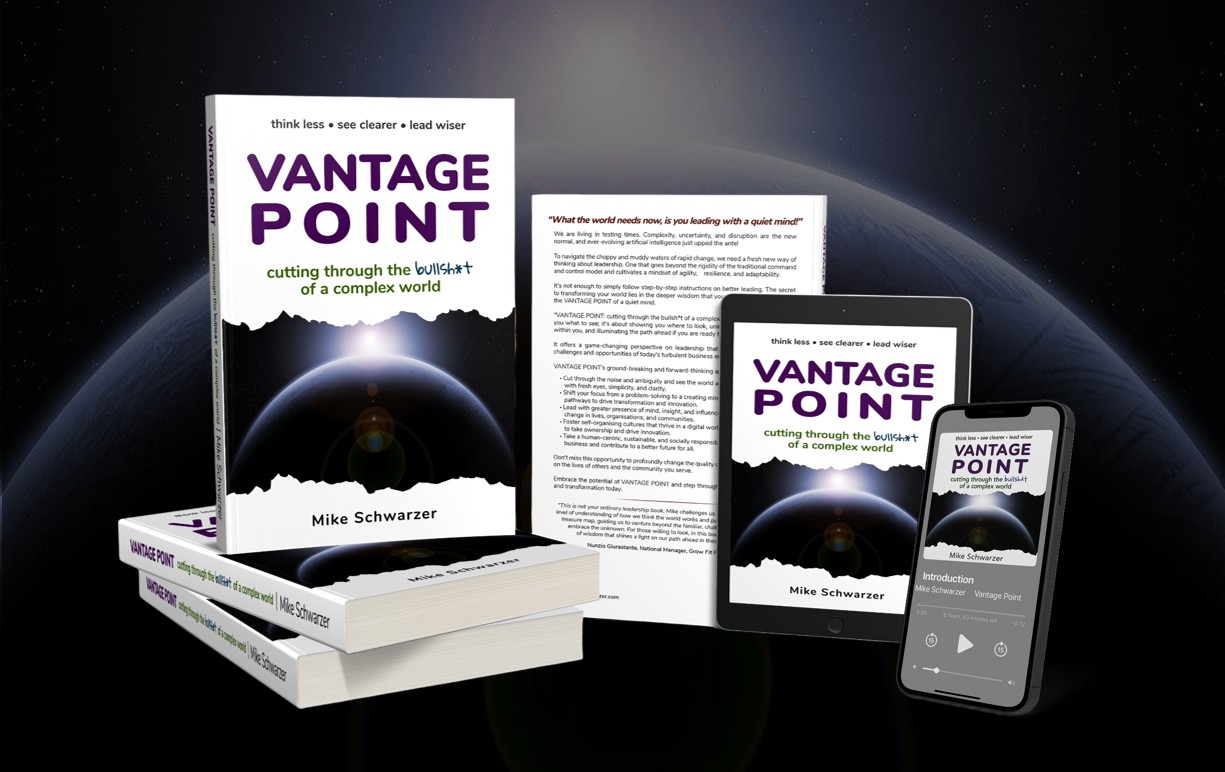
“Mike Schwarzer’s book, ‘VANTAGE POINT: cutting through the bullsh*t of a complex world,’ serves as both the torch and compass that illuminate the way and guide us as we step into uncharted territory, embark on new explorations, and pioneer innovative paths. ”Gabriella Sprott, Director & Co-Founder @ Yardner, Australia
VANTAGE POINT’s essence lies in preparing leaders for the unfolding challenges and future developments, not just in the realm of AI, but also in all the contributing factors that shape our complex world. It’s about elevating human consciousness, transcending the limitations of our ego-minds, and giving us hope to make our world a better place.
🚀 Elevate Your Leadership: Get VANTAGE POINT!
Grab your “VANTAGE POINT” from the digital shelves. Seize the opportunity to gain access to insights that will transform your approach to leadership.
To delve deeper and secure your copy, click here!
About Mike Schwarzer
Mike Schwarzer is the Author of VANTAGE POINT: cutting through the bullsh*t of a complex world – and the creator of VANTAGE POINT Conversations, a thinking partnership for senior leaders navigating the most complex moment in human history.
In a world drowning in noise, data and relentless pressure, Mike works with leaders who are starving for clarity. Not through frameworks, methodologies or advice – but through a quality of conversation that shifts something at a deeper level. Leaders walk in carrying the weight of it all. They walk out seeing things they couldn’t see before..
With thirty years exploring the cognitive, behavioural, and deeper dimensions of human performance, Mike brings a rare combination of rigour, wisdom and presence to the leaders he works with.
His work is grounded in a simple but profound insight – clarity is not something you achieve by working harder at it. It emerges. In the space between the thinking. In the quiet. In a conversation that doesn’t hand you an answer – but shifts how you see.
That shift changes everything. Not just how leaders lead. But how they decide, relate, and live.
If something in this just got a little quieter – VANTAGE POINT Conversations