“Don’t push the river, it flows by itself.” Fritz Perls
VANTAGE POINT Conversations, 13 May 2026
What becomes possible when we start leading people as they actually are?
There are moments in leadership that are hard to explain.
You’re in a meeting. Things are moving, but not really. Everyone is saying the right things, but nothing is quite landing.
A decision needs to be made. Pressure is building. So you do what you’ve been trained to do. You step in, tighten the frame, push for clarity, try to land it.
And for a moment, it works.
But something about it feels slightly off. Not wrong. Not a failure. Just forced. Slightly disconnected from what’s actually going on.
And for a moment, it works.
But something about it feels off.
Not wrong. Not a failure.
Just slightly forced. Slightly disconnected from what’s actually going on.
You leave with an outcome.
But not with a sense that anything genuinely shifted.
On the surface, everything is working.
The plans are sound. The strategy is clear. The metrics are being met.
And yet, there is a subtle friction that is hard to name.
You find yourself pushing more than you want to. Managing more than feels necessary. Trying to create movement where, for some reason, it is not naturally happening.
It is not a capability issue.
It is not a lack of effort.
If anything, it is the opposite.
Most of us do not stay with that feeling for long. We move back into action. Adjust the plan. Apply more pressure. Try to make things work.
But what if that friction is pointing to something we have been overlooking?
For a long time now, we have been thinking about human beings as if they were machines.
Not maliciously. Not even consciously.
But persistently. And at scale.
Governments, organisations, and institutions have been leading and designing systems around a version of us that does not quite exist. A version that responds predictably to inputs, can be optimised for outputs, and changes when the right lever is pulled.
And we, as individuals, have largely gone along with it. Managing ourselves the same way. Measuring our worth in metrics. Pushing ourselves like machines that should simply work harder.
And now, as AI begins to take on forms of thinking, analysis, and decision-making we once assumed were uniquely human, that underlying assumption is becoming harder to ignore.
This is not a piece about AI.
But it is a piece about what AI is making visible.
Because underneath the disruption, and the noise about relevance and keeping up, there is a quieter and more important question.
What does it actually mean to be human?
And have we, in our rush to organise and optimise and perform, been getting the answer wrong?
The mechanistic inheritance
The world we have built came with a hidden inheritance.
A way of seeing that most of us have never really questioned. To be fair, it served us extraordinarily well. It gave us systems, predictability, and scale. It allowed civilisations to organise, build, and coordinate at previously unimaginable levels. In many respects, it still does.
But somewhere along the way, a metaphor became a worldview.
We built machines. Then, without quite noticing, we began seeing ourselves through them.
A machine is inert until someone operates it. It does not adapt unless it is reprogrammed. It has no inner life, no instinct toward health, no wisdom of its own. It can be optimised, replaced, discarded. Change in a machine always comes from the outside.
You cannot ask a machine to find its own way.
The problem is not that we built machines.
The problem is that we started to think we were one.
Dee Hock, who built Visa into one of the most complex financial systems in the world, put it plainly:
“People are not ‘things’ to be manipulated, labeled, boxed, bought, and sold. Above all else, they are not ‘human resources.’ They are entire human beings, containing the whole of the evolving universe, limitless until we start limiting them.”
What makes this worth sitting with is where it came from. Hock was not a critic on the outside throwing stones at the system. He built within it. He understood complexity and scale as well as anyone. And from that vantage point, not despite it, he arrived at the limits of treating people and organisations as if they were machines.
The river knows its course
Here is what I keep coming back to.
We are not machines. We are living adaptive systems.
Not as a metaphor. As a description of what we actually are.
We are self-organising. We are responsive. We carry within us a remarkable capacity for adaptation, emergence, and coherence. Not because someone designed it in, but because it is intrinsic to our nature.
Think about it.
A forest does not need a manager. An immune system responds to threats no designer could have anticipated. A river does not deliberate about its destination. It reads the landscape, responds to what it meets, and finds its course.
Not because it is forced to.
Because that is simply what rivers do.
We are of this same order.
“When we try to pick anything out by itself, we find it hitched to everything else in the universe.” John Muir
We are not separate units to be optimised in isolation. We are relational, contextual, and woven into everything around us.
To manage a human being as if they were a discrete component in a mechanical system is not just philosophically questionable. It works against the very intelligence we are trying to draw out.
And yet, look at how we approach change.
We impose it. We cascade it. We project-manage it. We create urgency, apply pressure, measure resistance, and then wonder why transformation is exhausting and so rarely sticks.
We are, in essence, trying to push the river.
And then writing reports about why the river is not cooperating.
Two minds
Something I have come to notice, in myself as much as anywhere, is that there seem to be two quite different places we can operate from.
The first could be called Ego Mind.
This is the part of us that calculates, defends, compares, and controls. It has its place. It has kept us safe in more ways than we can count. But it has a particular relationship with uncertainty.
It cannot stand it.
So it plans, manages, pushes, and pulls. It treats the world as a problem to be solved and other people as variables in that problem.
“The intuitive mind is a sacred gift and the rational mind is a faithful servant. We have created a society that honours the servant and has forgotten the gift.”
Albert Einstein
The second could be called Deeper Mind.
It is harder to describe, not because it is mysterious, but because it operates below the level of language and analysis. It is the part of us that knows without quite knowing how it knows.
It shows up in a conversation that suddenly becomes real. In a decision that arrives with unexpected clarity. In those moments when we are not performing or protecting, but simply present.
Wisdom, as Gregory Bateson put it, is the intelligence of the system as a whole.
Not the part trying to control the system.
Not just the intelligence of the plan.
The whole. Including dynamics, relationships, and signals that do not neatly fit inside our models.
For a leader, this matters.
Because the moment we rely only on what we can analyse and direct, we narrow the field. We start working with a partial picture and call it reality.
Something else becomes available when that grip softens. When attention widens just enough to take in more of what is actually there.
That is what Deeper Mind is pointing to.
Not less intelligence.
A more complete form of it.
What changes when we stop pushing
When people, and by extension teams and organisations, begin operating more from Deeper Mind, something shifts.
Not dramatically. Not all at once. But you can feel it.
“We can’t impose our will on a system. We can listen to what the system tells us, and discover how its properties and our values can work together to bring forth something much better than could ever be produced by our will alone.”
Donella Meadows
This is not passivity.
It is a different quality of attention. The difference between forcing and listening. Between managing and genuinely participating.
In practical terms, this shows up in small but significant ways.
Decisions become less about forcing alignment and more about seeing clearly what is actually there.
Conversations slow down just enough for something real to emerge, rather than being driven to premature closure.
Leaders find themselves needing to control less. Not because standards drop, but because people begin to engage from a different place.
And problems that felt stuck begin to move. Not because they were solved directly, but because the conditions around them changed.
The payoff is not abstract.
It shows up as better judgement under pressure.
More resilient and engaged teams.
Change that actually lands, rather than being continuously re-driven.
And perhaps most noticeably, a reduction in the quiet exhaustion that comes from constantly trying to push what is not ready to move.
Change, rather than something that has to be inflicted, begins to arise from within.
Not chaotically. Not without direction.
But in the way living systems naturally change when the conditions support it.
An invitation rather than a conclusion
I hold this as an open question rather than a finished thought.
We are at a moment, in organisations, in societies, and in leadership itself, where the mechanistic frame is under real strain. Not because someone decided to reject it, but because reality keeps pointing to something more complex.
The world is not behaving like a machine.
People are not behaving like machines.
And as AI continues to evolve, not just as a tool, but as something that increasingly participates in how decisions are informed and work gets done, it quietly challenges long-held assumptions about where human value actually lies.
If anything, it sharpens the question.
Because if machines can now analyse, generate, and decide, what is left that is genuinely, irreducibly human?
Not as a threat. As an invitation.
What if we paused and asked: what if the premise was wrong from the beginning?
What if human beings, given conditions that honour their nature rather than suppress it, are already oriented toward something like wisdom and coherence?
What if we do not need better management so much as a more truthful understanding of what we actually are?
I do not know exactly what that looks like at scale.
But I notice that whenever I stop trying to force something, in myself, in a conversation, or in a working relationship, and instead create space for what is already moving to move, something tends to find its way.
Something I could not have engineered.
The river does not deliberate about its course. It moves with what it meets, finds its own coherence, and arrives. Not because it forced its way through, but because that is simply what rivers do.
Perhaps we are not so different.
With gratitude,
Mike
P.S. Maybe the river knows something our systems sometimes forget: not everything alive needs to be pushed in order to move. 🍃
P.P.S. If something in this stayed with you, these are also the kinds of conversations I explore through Vantage Point Conversations. You’re always welcome to reach out.
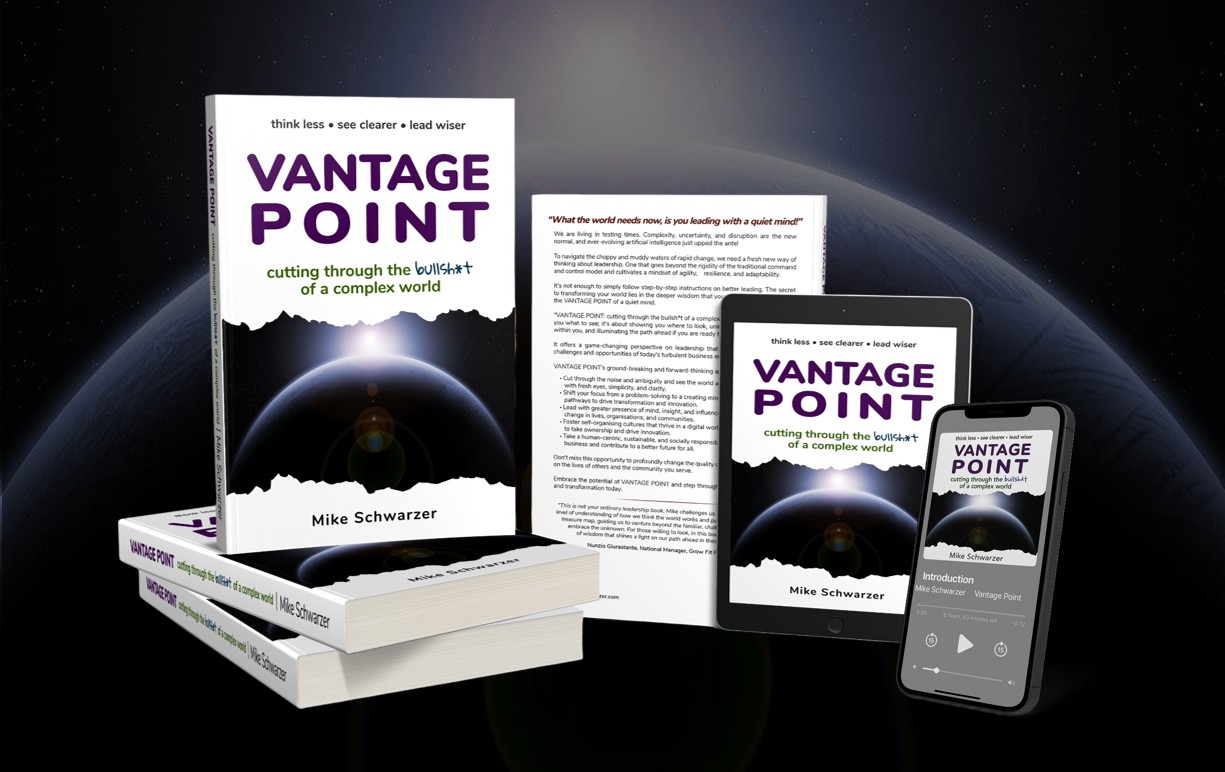
“Mike Schwarzer’s book, ‘VANTAGE POINT: cutting through the bullsh*t of a complex world,’ serves as both the torch and compass that illuminate the way and guide us as we step into uncharted territory, embark on new explorations, and pioneer innovative paths. ”Gabriella Sprott, Director & Co-Founder @ Yardner, Australia
VANTAGE POINT’s essence lies in preparing leaders for the unfolding challenges and future developments, not just in the realm of AI, but also in all the contributing factors that shape our complex world. It’s about elevating human consciousness, transcending the limitations of our ego-minds, and giving us hope to make our world a better place.
🚀 Elevate Your Leadership: Get VANTAGE POINT!
Grab your “VANTAGE POINT” from the digital shelves. Seize the opportunity to gain access to insights that will transform your approach to leadership.
To delve deeper and secure your copy, click here!
About Mike Schwarzer
Mike Schwarzer is the Author of VANTAGE POINT: cutting through the bullsh*t of a complex world – and the creator of VANTAGE POINT Conversations, a thinking partnership for senior leaders navigating the most complex moment in human history.
In a world drowning in noise, data and relentless pressure, Mike works with leaders who are starving for clarity. Not through frameworks, methodologies or advice – but through a quality of conversation that shifts something at a deeper level. Leaders walk in carrying the weight of it all. They walk out seeing things they couldn’t see before..
With thirty years exploring the cognitive, behavioural, and deeper dimensions of human performance, Mike brings a rare combination of rigour, wisdom and presence to the leaders he works with.
His work is grounded in a simple but profound insight – clarity is not something you achieve by working harder at it. It emerges. In the space between the thinking. In the quiet. In a conversation that doesn’t hand you an answer – but shifts how you see.
That shift changes everything. Not just how leaders lead. But how they decide, relate, and live.
If something in this just got a little quieter – VANTAGE POINT Conversations